
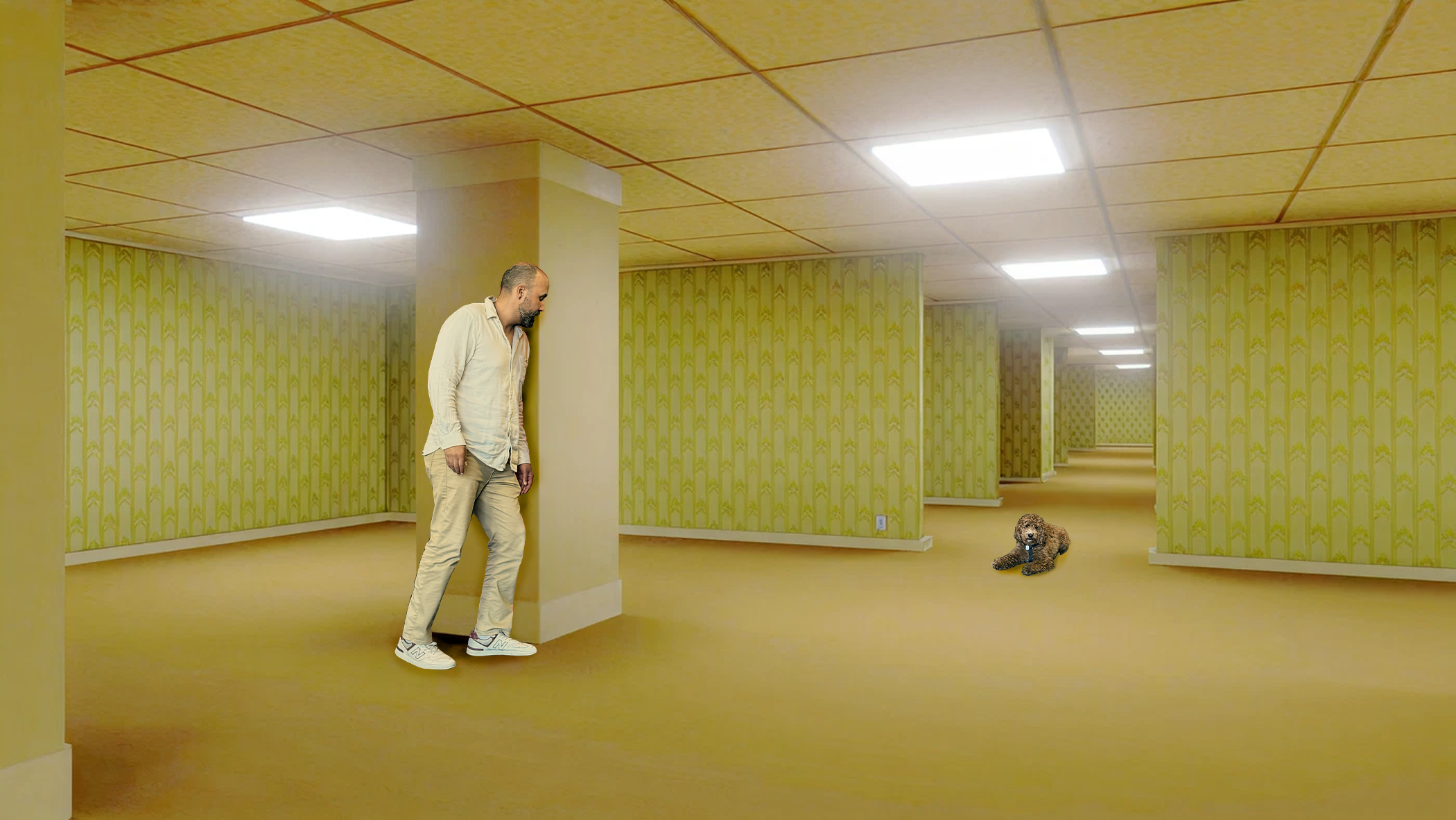
I went to see The Backrooms movie knowing almost nothing about the mythology behind it. In fact, I had never even seen the original image.
My friend Scott wanted to go, so I tagged along. I watched the trailer and thought, "Mysterious yellow walls and hallways that feel like a confusing nightmare? I’m in." When the movie ended, Scott gave me the quick version of the lore, explained what "noclipping out of reality" meant, and pointed me toward the rabbit hole that millions of people had already disappeared into. I would like to say I entered the Backrooms through the back door, but my friends said they would stop talking to me for real this time if I did.
Like many others, in an effort to create scenarios where I could bring this all up and sound smart, I spent the next few days watching videos, reading articles, and exploring timelines. An entire mythology had somehow grown out of a single photograph posted online.
$80 Million So Far from Yellow Walled Hallways
What fascinated me wasn't just the film. It was trying to understand why a photograph of an empty room had become one of the most successful horror concepts of the last decade. The movie reportedly cost around $10 million to produce and generated more than $80 million in North America during its opening weekend, with the overwhelming majority of its audience under the age of 35. Those young whipper snappers are willing to go to the theater after all.
Think about that for a moment. No iconic monster. No masked killer. No haunted doll. Just commercial carpet and the overwhelming feeling that somebody is about to ask you to fill out a T1 General Income Tax and Benefit form. My god, that just stressed me out writing that.
The Basement of Broken Dreams
A lot of people are asking why the Backrooms are scary. I think they are about dissociation. That is the feeling of being physically present somewhere, but emotionally and spiritually absent.
Years ago, I ran into a friend I hadn't seen since high school. He was charismatic, intelligent, and had this cool Caribbean accent. I pulled over to say what’s up and offered him a ride home. When we arrived at his spot, he told me he wanted to show me a new business venture in the basement.
The floor was unfinished concrete. Parts of it were wet. Sitting in the middle of this basement were a series of rusted cubicle walls arranged into makeshift office corridors. There were no desks. No computers. Just these strange office partitions leading nowhere. He started pitching me like Alec Baldwin’s character in Glengarry Glen Ross, asking if I had the "cahoonas" to invest.
I remember standing there trying to figure out how to get out of that basement like that Homer Simpson backing into the bushes meme. I had such a hard time articulating why this common office divider was so dreadful. I was standing next to a person who had become disconnected from reality, in a place that was relatively benign but unbelievably creepy.
Years later, walking out of a theater, I had that same sensation in my bones. I almost wrote “in my wet bones,” which is a creepy thought. Like, your bones are wet right now. Deal with that.
The Ghost of Robert Propst
The Backrooms image draws heavily from the incredibly bland, gray paneled aesthetic of 1970s and 1980s offices. This look was actually pioneered by American designer Robert Propst.
Propst designed the modular "Action Office" for Herman Miller in the 1960s to create flexible, autonomous, and utopian workspaces. He wanted to liberate workers. Instead, corporations warped his vision into the "cubicle farm." It is the ultimate design irony because a system built for freedom became the visual shorthand for a soul crushing maze.
This aesthetic is a modern Gothic. For previous generations, horror lived in Victorian mansions with isolation, decay, and hidden secrets. But younger audiences didn't grow up in Victorian mansions. They grew up in shopping malls, government buildings, and schools during summer break.
The Dalí of the DMV
When you look at the Backrooms, you are looking at a Salvador Dalí painting made of industrial materials. Dalí was the master of surrealism, taking familiar objects and stretching them into impossible, melting, and dream like landscapes. The Backrooms do the same thing with spatial design. It takes a "standardized" office layout and stretches it into infinity.
Sidebar: If Dalí had been forced to work a 9 to 5 at a mid level insurance firm, the Backrooms is exactly what he would have painted.
Experts like Dr. Coltan Scrivner suggest that our pull toward these spaces is "recreational fear," which is a way to simulate threats. We are testing our ability to survive a world that feels increasingly "off." To Gen Z and Alpha, what previous generations saw as "efficiency," they experience as emptiness.
The Sky Story Perspective: Design That Connects
At Skystory Creative, we have increasingly found ourselves working in the space between architecture and emotion. Through our Indigenous design integration projects, we have spent a lot of time thinking about how spaces can carry story, memory, and identity.
If the Backrooms teach us anything, it is that function alone isn't enough.
- Architecture asks how a building stands.
- Interior Design asks what goes inside it.
- Spatial Design asks how it feels to move through it.
Many of the most powerful Indigenous spaces represent the opposite of the Backrooms. They root people in place. They connect people to history. They feel human.
The Backrooms are not frightening because they are ugly. They are frightening because they are disconnected. They are disconnected from story, community, and meaning. The future of design isn't simply creating spaces that function, it is about creating spaces that remind us we belong.
Because people can survive without beautiful spaces. What they struggle to survive without are meaningful ones.
.webp)