
On Sunday night, I was sitting on the couch with Bean, my ridiculously adorable dog, getting ready for the week—not just emotionally, but practically.
There’s a lot happening right now.
Indigenous art installations going into a federal building in Northern Ontario.
An exhibition opening in Las Vegas.
Strategy work with an accessible media company called ScribeWire.
So I was doing what I almost always try to do… getting ahead of it.
And then the thunder hit.
You heard it too. It went KRAK-BOOM. Not BOOM-KRAK-A-LAKA… but KRAK-BOOM.
Right at the beginning of the snowstorm.
Bean looked at me. I looked at her. We looked at we.
Quickly, united in purpose and confusion, we turned toward the window.
The snow was coming down hard. Some of it was sticking to my window. The weather app’s orange alert was being realized in real time.
I sent a message to the Sky Story team:
“Let’s work from home tomorrow.”
I was met with a cascade of upward-pointing thumbs.
Quick sidenote: I read that Gen Z believes the thumbs up is rude and sarcastic. I now give everyone a thumbs up for as many things as possible. You do something good = thumbs up from Cliff. You wave hi to me = thumbs up from Cliff.
Okay, back on snow track.
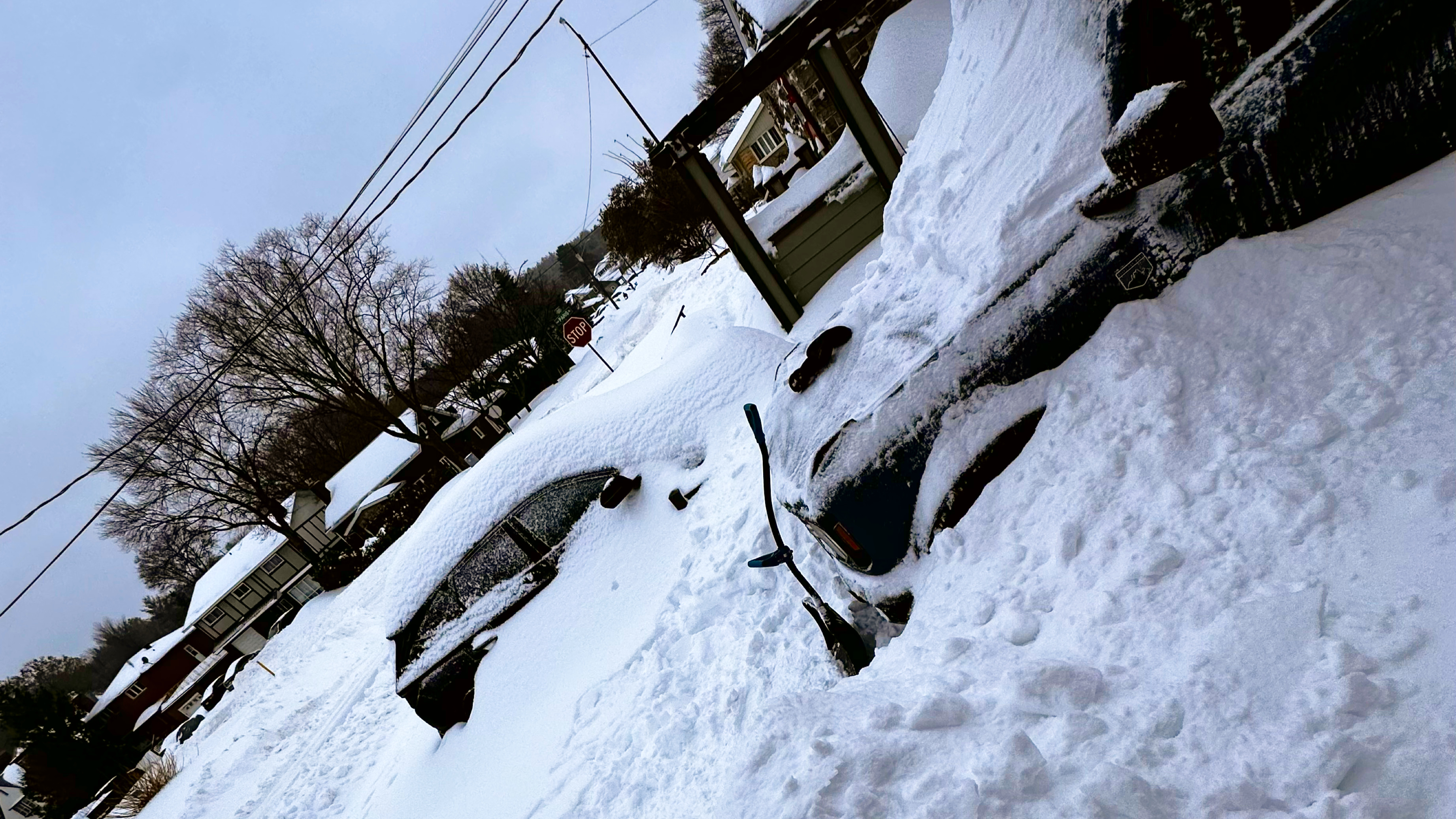
By the next day, everything was buried. Some may even say… “Sud-buried.”
Reports across Sudbury estimated around 40–50 cm of snow. With wind and drifting, it’s hard to pin down an exact number, but it was enough for people to compare it to the biggest storms on record—some even mentioning the late 1950s.
People stood in their driveways, hands on hips, shaking their heads:
“Snow way I’m going to work today.”
In the aftermath, I stared at the top half of my Bronco Big Bend sticking out of the snow. It felt surreal, like being on a movie set.
Bean was running around, disappearing into drifts.
I grabbed a shovel, got a few passes in, and quickly realized—this wasn’t going to be quick.
Then my neighbour texted me.
She needed a hand. Her little dog needed a path cleared.
I obliged.
And then I started noticing versions of this everywhere.
People in their driveways.
Shoveling not just their own space, but someone else’s.
Clearing paths.
Helping push cars.
Stopping to check in.
No coordination. No plan.
Just… doing it.
It’s interesting how naturally that kind of thing happens.
People are always talking about community—how to build it, strengthen it, design it. You’ve heard it all before.
Then something like this happens, and none of it feels complicated anymore.
It doesn’t feel trite. It doesn’t overwhelm.
It just becomes intuitive.
Everyone is dealing with the same thing.
Everyone understands the moment without needing it explained.
“Yeah… this is a lot of snow.”
That’s all it takes.
And from there, something opens up.
It makes you wonder if comfort actually gets in the way sometimes.
When everything is easy, everyone stays in their lane.
Head down. In and out. Efficient.
But add a little shared friction, and our ancestral instincts kick in.
We start working together.
We notice each other.
We step into our roles.
As a creative director, I spend a lot of time trying to create these kinds of moments.
My team asks:
Where’s the human in this?
Why would anyone care?
Will people see themselves in this story?
That’s where design thinking comes in.
Find the common ground.
Surface it.
Make it visible.
But out there, in the middle of a storm, none of that was necessary.
The common ground was obvious.
No strategy sessions required.
At one point, I stopped and looked around.
Snow everywhere.
People working at their own pace.
Talking more than usual.
Helping more than usual.
And it felt… simple.
Like this is what a community is supposed to look like.
By the end, driveways were cleared—well, mostly. Roads reopened. Life resumed.
But for a little while, there was a window where things shifted.
Where inconvenience did something unexpected.
It brought people together.
And maybe that’s the part worth holding onto.
Not what the storm covered—
but what it uncovered about us.
.webp)